

Australia's online furniture market hit roughly $1.4 billion in 2026, spread across some 730 businesses (IBISWorld, 2026). That's a lot of choice for a parent who just wants one decent bed. Most kids single bed buying guides either oversimplify things ("just pick something cute") or bury you in bunk-bed rules that don't apply to a single frame at all.
This guide sticks to what matters for a single bed: frame material, slats, safety features, storage, price, style and how it holds up in an Australian home. We've deliberately left bunk beds out of scope. The rules, sizing and safety features that apply to bunks are a different conversation, and folding them in here would just muddy what a single-bed shopper needs to know.
By the end you'll know what to look for before you open our kids single bed range, and what you can skip worrying about.
Key Takeaways
- Frame material (solid timber, engineered wood, metal, upholstered fabric or PU leather, or foam) is the single biggest driver of price and lifespan.
- Entry-level single beds start around $200–$300; ALL4KIDS' own range starts from $299.95.
- A removable side rail and a low bed height matter more for younger kids than any brand name.
- Underbed storage drawers can replace a separate chest of drawers in a small room.
What's the Right Single Bed for Your Child's Age and Room?
Most Australian kids move from a cot to their first bed somewhere between 18 months and 3.5 years old, and a well-chosen single bed can then last through primary school and often into the early teens. There's no single "correct" age. Readiness matters more than a birthday.
School-aged children need roughly 9–11 hours of sleep a night, and toddlers and preschoolers need closer to 10–14 hours (Sleep Health Foundation, 2025). A bed your child is excited to sleep in, rather than one they're merely tolerating, helps with that routine.
For sizing, the two realistic single-bed options are:
- Standard single (92cm x 187cm, the standard Australian single mattress size): suits smaller rooms and younger kids
- King single (107cm x 203cm): extra length for kids aged 8 and up, or anyone already tall for their age
Measure the room before you shop, not after delivery. In a shared sibling room, a single bed's smaller footprint usually beats a king single, and if you're only just transitioning off a cot, our cot-to-bed transition range covers exactly that stage before you commit to a full-size frame.
How do you know your child is ready, rather than just old enough? A few practical signs matter more than age alone: they're climbing out of the cot on their own, they've outgrown the cot mattress length, or they're showing interest in a "big kid" bed after seeing one at a friend's place. None of these need to happen all at once. Most families see one or two signs first, and the rest follow within a few months.
Room layout deserves the same attention as the bed itself. A single bed pushed against a wall frees up the most floor space, which matters in a typical Australian kids' room where a wardrobe, desk and toy storage are all competing for the same square metres. If you're furnishing a shared room, sketch the layout, including walkway space and door swing, before you order either bed.
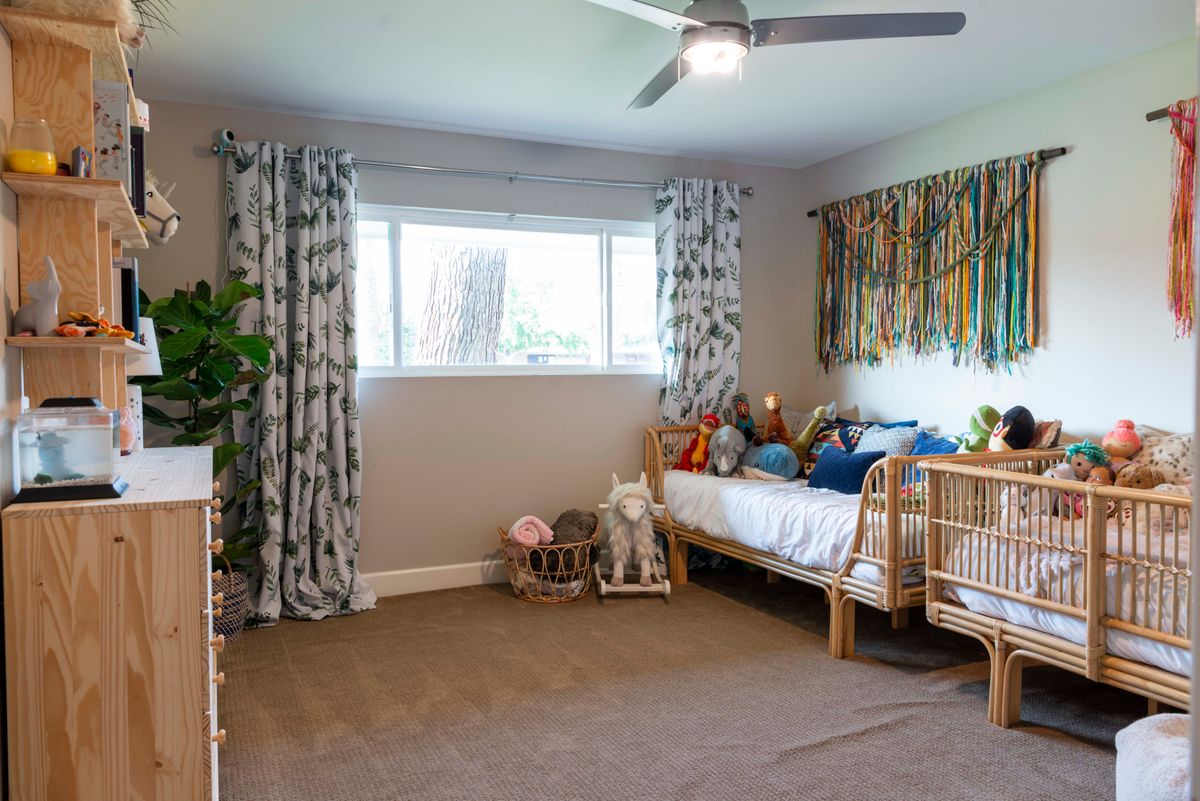
Kids Bed Frame Materials Compared: Timber, Engineered Wood, Metal, Upholstered & Foam
Frame material is the single biggest factor in how long a bed lasts and what it costs. Solid timber and metal frames typically outlast engineered wood by years, while upholstered and foam options trade some of that longevity for comfort and softer edges. Here's how the five options compare.
Solid timber
Pine, oak and beech frames are the durability benchmark. A solid timber kids bed costs more upfront but shrugs off years of climbing, jumping and general kid-proofing, and it ages well rather than looking tired after two years. Solid joinery also means a solid timber frame can usually be re-finished or repainted down the track, which engineered wood generally can't handle more than once.
Australia has around 1.2 million hectares of forest certified under the FSC scheme, out of roughly 11.4 million hectares covered by certification schemes overall (Forestry Australia, 2025). Look for FSC-certified timber if sustainability factors into your decision. Most reputable suppliers list it on the product page.

Other timber / engineered wood
MDF, particleboard and plywood-veneer frames are the budget-friendly option, and there's nothing wrong with them for a bed that only needs to last a few years. Look for E1-grade or "No Added Formaldehyde" (NAF) certified engineered wood. It relies less on adhesive resins than uncertified boards. A veneer finish also scratches more easily than solid timber, so it's a reasonable trade-off for a toddler's first bed, but less ideal as a "last one you'll ever buy" purchase.
Metal frames
Steel or iron frames are lightweight, rigid and usually sit in the budget-to-mid price bracket. They won't warp with humidity the way timber can, though they read as less "warm" in a styled bedroom. Ask which finish a metal frame uses: powder-coating resists chips and scratches better than paint.
Upholstered beds: fabric and PU leather
An upholstered kids bed, in fabric (linen, velvet, boucle) or PU leather, gives a softer, more "grown-up" look that older kids and tweens often prefer over a plain timber frame. Here's the part most buying guides skip: the frame underneath the upholstery can itself be solid timber or engineered wood. Two upholstered beds can look identical in photos and differ a lot in how long they last. Check what's under the fabric, not just what covers it.
Fabric and PU leather also differ in day-to-day maintenance. Fabric upholstery is warmer and softer against the skin but can stain, so ask about a removable or spot-cleanable cover before you buy, especially for a younger child still prone to spills. PU leather wipes clean in seconds, which makes it the lower-maintenance choice for a busy household, though it can feel cooler to the touch on a cold morning.
Every bed in our PU leather single bed range also includes a raised side rail as standard, built into the frame design to help stop a child rolling off the edge onto the floor overnight. More on why that matters in the safety section below.

Foam beds
A foam toddler bed is a low-to-floor, Montessori-style option that's becoming more common in the kids' furniture market. There's no hard frame, no sharp corners, and almost nothing to bruise a shin on: useful safety features for a toddler fresh out of a cot. They trade away structural longevity, though, so treat this as an early-childhood stage rather than a bed that grows with an older child.
Most families move on from a foam bed within a year or two, once a child is sleeping reliably and no longer needs the extra-forgiving fall height. When that happens, the transition is usually straight into a standard single frame (timber, engineered wood or metal) rather than a second interim bed. Factor that into the budget from the start if you're buying a foam bed as a short-term stage.
| Material | Durability | Typical price | Best for |
|---|---|---|---|
| Solid timber | Highest | $$$ | Long-term, one bed for years |
| Engineered wood | Moderate | $ | Budget-conscious, shorter-term use |
| Metal | High | $$ | Humid climates, minimalist styling |
| Upholstered (fabric/PU leather) | Depends on base frame | $$–$$$ | Tween bedrooms, softer look |
| Foam | Lower | $ | Toddlers, cot-to-bed transition |
Slat Materials and Structural Stability: What Actually Holds Up
Slat quality, not just the frame material, determines whether a bed stays sturdy for years. Timber slats spaced under roughly 7cm apart give the best long-term mattress support, and this detail is easy to overlook when you're focused on how a bed looks.
The three common slat types are timber slats (solid, minimal flex over time), plywood or engineered-wood slats (common on budget frames, fine as long as they're thick enough), and metal slat frames (rigid, good for heavier mattresses, less "give" underfoot).
Slat count matters almost as much as slat spacing. A frame with too few slats concentrates weight on fewer contact points, which speeds up sagging in the middle of the mattress over time. You won't notice it in a showroom, but you'll notice it eighteen months in. As a rough guide, more slats spread evenly beat fewer, wider-spaced ones, even when the material is otherwise identical.
A mismatched mattress-to-frame fit is one of the most common structural issues we see. Gaps between the mattress edge and the frame rail aren't just uncomfortable, they're a hazard. Give any bed a firm shake before you commit; a well-built frame shouldn't wobble at the joints. Check the manufacturer's weight rating too, especially for a bed you expect to still be in use during the early teen years.
Our customer support team hears the same two complaints far more than any other: a loose joint after assembly (usually a missed bolt, not a faulty part) and a mattress that doesn't quite fit the frame. Both are avoidable if you check the fixings and confirm the exact mattress size before you buy.
Safety Features to Look For: Side Rails, Bed Height and More
The two safety features that matter most on a kids single bed are a removable side rail and the frame's overall height off the floor. A lower frame shortens the fall distance if a child rolls out mid-sleep, while a taller frame benefits from a rail until they're a few months into sleeping through the night without it.
Beyond height and rails, look for rounded corners and edges (fewer bruised shins in the dark), smooth splinter-free finishes, non-toxic or low-VOC paint and coatings, and, if the frame uses MDF or particleboard, E1-grade or NAF certification for the engineered wood.
How low should a frame be? A low-profile bed (foam or timber house-style frames both come in low variants) sits close enough to the floor that a fall barely registers, which is why they're popular for a child's first bed. A standard-height frame sits higher off the ground and makes life easier for parents doing the daily bed-making, but it's the one that benefits most from a rail early on.
Does your child still need a rail? Most kids fresh out of a cot or toddler bed benefit from one for the first few months on a full-size single. Once they're consistently sleeping through without rolling out, it usually comes off without any fuss. If your child is a restless sleeper or still climbing in and out at night, there's no harm in keeping the rail on longer than you think you need it. It's easier to remove a rail early than to add one back on after a fall.
This isn't a given across the market: some retailers sell the guard rail as a separate add-on rather than including it with the bed. Every ALL4KIDS PU leather single bed comes with a raised side rail built in, to stop a child rolling off the mattress edge onto the floor. You're not paying extra or hunting down a compatible accessory afterwards.
Underbed Storage: Making the Most of a Small Bedroom
A kids bed with underbed storage can replace a separate chest of drawers entirely, which matters in the smaller bedrooms and shared sibling rooms common across Australian homes and apartments.
You'll generally see two approaches: built-in drawers under the frame, or open underbed space for storage boxes and bins. Drawer-style storage costs a little more and adds some weight to the frame, but pay for soft-close mechanisms if you can. They avoid pinched fingers: a small, everyday safety detail, not a regulatory checkbox.
Open underbed space is the cheaper option and works well with fabric storage boxes, but it relies on you (or eventually your child) keeping it tidy. A drawer at least hides the mess behind a front panel. If floor space is tight, a bed with two or three drawers can realistically absorb a season's worth of clothing, often enough to skip a separate dresser for a toddler or early-primary-aged child.
A separate chest of drawers still makes sense for very young kids who can't yet safely reach or use bed-level drawers. For everyone else, pairing a storage bed with our broader kids storage range is usually the more space-efficient combination. See our storage ideas for small kids' rooms guide for more on this.
How Much Does a Kids Single Bed Cost in Australia?
Budget kids single beds in Australia start around $200–$300, mid-range frames run $400–$800, and premium solid-timber or upholstered designs sit at $800–$1,200 or more. ALL4KIDS' own single bed range starts from $299.95.
What drives the price within each tier: frame material, slat quality, whether storage drawers are included, and brand. Think in terms of cost-per-year-of-use rather than sticker price alone. A $250 engineered-wood frame that needs replacing in three years works out to roughly $83 a year, while an $800 timber bed that lasts a decade averages closer to $80 a year. The sticker price alone tells you almost nothing.
Australia's broader furniture retail market is worth an estimated $14.6 billion in 2025, projected to reach around $22.7 billion by 2035 (IBISWorld, 2025). Kids' furniture is one of the categories driving that growth, which is partly why price points and quality levels have expanded so much in the last few years. More choice is good news for shoppers, provided you know what you're comparing. Browse our full kids single bed range to compare across all three tiers.
Choosing a Style That Grows With Your Child
Neutral, convertible designs hold their appeal, and their resale value, longer than heavily themed beds, but a novelty frame does a lot for a child's excitement about their own room. The right balance comes down to your child's age and how long you want the bed to last.
Beyond the classic princess or castle bed, two novelty styles come up constantly: a house-style bed frame (an open timber silhouette shaped like a little house, popular in Montessori-style and floor-bed setups, available at standard or low-profile height) and a car-style bed, a moulded frame shaped like a vehicle. Car beds are almost always low-profile and suit younger kids best, since the novelty shape has a shorter appeal window than a house-style frame or a neutral upholstered design.
House-style beds tend to age better than car beds for one simple reason: the shape reads as "cosy cabin" rather than "toddler toy," so a six-year-old doesn't feel like they've outgrown it the way they might a fire-truck-shaped frame. If you're choosing between the two purely on longevity, that's the deciding factor more often than price.

For a tween starting to outgrow novelty shapes, an upholstered fabric or PU leather bed reads as a deliberate style upgrade rather than "still a little kid's room." If you're weighing up a themed vs. neutral direction, our themed kids furniture ideas post has more inspiration, and the full kids bedroom furniture collection covers pieces to match whichever direction you land on.

Mattress Pairing, Room Size and Climate Considerations for Australian Homes
A mismatched mattress-to-frame fit is one of the most common, and easily avoidable, issues with a new bed. Always match the standard Australian single mattress size (92cm x 187cm) exactly to the frame, rather than assuming "single" means the same thing everywhere.
Mattress firmness matters for a growing spine, so don't default to whatever's cheapest. In a shared sibling room, measure floor space for both beds plus a walkway before you buy either one. It's a much easier problem to solve on paper than after delivery.
Australia's climate adds a couple of practical wrinkles most buying guides skip. Breathable mattress and bedding materials matter more here than in cooler climates, particularly through summer in northern states. Look for cotton or bamboo-blend covers over fully synthetic ones if your child's room doesn't get airflow or air conditioning overnight. In a coastal or humid region, solid timber can expand and contract slightly with moisture over time. That's not a dealbreaker, but it's a reason to choose a sealed or powder-coated finish over raw timber.
Room ventilation matters more than most parents expect, too. A bed pushed hard against an exterior wall in a poorly ventilated room can trap warmth and humidity behind the headboard, which isn't ideal for timber finishes or for a comfortable night's sleep in summer. Leaving even a small gap between the frame and the wall costs you nothing and helps on both fronts.
Delivery, Assembly and Warranty: What to Expect Buying Online in Australia
Most kids beds delivered in Australia ship flat-pack, with typical timeframes of around 5–10 business days for metro addresses and longer for regional delivery. Basic tools and roughly an hour or two are all you need for assembly on a standard single frame.
An Australian-based warranty and support line is the biggest trust differentiator between a local retailer and an overseas drop-shipped listing. It's the difference between someone answering the phone when a bolt is missing and emailing a warehouse on the other side of the world. ALL4KIDS has been 100% Australian-owned since 2010, so sizing questions, missing-part follow-ups and warranty claims all go through a local team.
Assembly on a standard single frame typically needs nothing more exotic than a Phillips-head screwdriver and an Allen key, both usually included in the box. Budget an hour for a simple slat-and-headboard frame, closer to two if the bed includes storage drawers or a more elaborate headboard design. It's a two-person job once the mattress goes on top of a heavier frame.
Before you buy, check the return policy for sizing mistakes specifically. It's the single most common reason parents end up exchanging a bed (a king single ordered when a standard single would have fit, or vice versa). A clear, no-fuss exchange policy on sizing matters more in practice than an extra few months of warranty fine print. Our complete kids room furniture checklist is a good next stop if you're furnishing the rest of the room at the same time.
How Does ALL4KIDS Compare to Other Kids Single Bed Retailers in Australia?
Prices and specs across kids single bed retailers in Australia vary more than most parents expect. Even within the same $300–$500 bracket, what's included (a side rail, storage drawers, the actual frame material under the marketing photos) differs a lot. Here's how ALL4KIDS stacks up against nine other retailers commonly compared side by side, including HipKids, Amart Furniture and B2C Furniture.
| Retailer | Example single bed | Price (AUD) | Frame material | Side rail | Underbed storage |
|---|---|---|---|---|---|
| ALL4KIDS | PU leather single bed range (e.g. Kinsley, Brooklyn Heart) | From $299.95 | PU leather over timber-based frame | Included standard on the PU leather range | Available on select models |
| HipKids | MIA Single Upholstered Bed | $529.99 | Fabric upholstered | Not specified | Not specified |
| Amart Furniture | Jessalyn Single Bed | $278.10 (was $349) | Fabric/leather upholstered | Not specified | Not specified |
| B2C Furniture | Coco Single Bed with Storage | Price varies by sale (check site) | Hardwood (rubberwood) | Not specified | Yes, 2 drawers included |
| Boori | Neat Single Bed | $369.95 | Engineered timber (particleboard/plywood/Araucaria + LVL base) | Guard panel sold separately | No |
| Fantastic Furniture | Willow Single Bed Frame | $179 | Metal, budget tier | Not specified | No |
| Kmart | Ausway Wooden Bed Frame (house-shape, single) | Budget tier (check site) | Solid pine | Not specified | No |
| IKEA | SLÄKT Bed Frame with Storage | $489 | Engineered wood (particleboard/fibreboard) | Not specified | Yes, 4 drawers included |
| Mocka | Imogen Single Bed | $365.49 (was $429.99) | MDF, metal & pine with fabric upholstery | Not specified | No |
| Temple & Webster | Kids' Cloud Boucle Single Bed Frame | $249 | Boucle upholstered | Not specified | Not specified |
Prices, materials and features above were checked against each retailer's own product pages in September 2026 and are shown for general comparison only. Retailers change pricing, stock and specifications regularly, so confirm current details on their site before relying on this table. "Not specified" means the retailer's product listing didn't state that feature either way, not that the bed necessarily lacks it.
Several retailers in the $350–$500 range don't mention a side rail at all in their product listing, and Boori sells its guard panel as a separate accessory rather than including it. If a side rail matters for your child's transition, and for most kids fresh off a cot it does, confirm that detail before you buy anywhere, not just with us.
The Bottom Line on Buying a Kids Single Bed
Material determines lifespan and price more than any other single factor, so decide your budget tier before you fall in love with a look. A removable side rail and a lower frame height matter most for younger kids, underbed storage can replace a chest of drawers in a small room, and slats deserve as much attention as the frame itself.
Match the mattress size exactly, and buy from a retailer with Australian-based warranty support. That's the difference-maker when something needs fixing six months in. Kids' furniture in Australia keeps trending toward more sustainable materials and smarter storage integration, so what's on the shelves now may look different again in a few years.
Ready to compare frames in person? Browse the full ALL4KIDS single bed range, or get in touch with our team for sizing and material advice.


